

慢性肾病患者最该警惕的并发症:继发性甲状旁腺功能亢进,为何被称为“隐形骨骼杀手”
MICOT
点击蓝字 关注我们

Slide to view different languages
滑动查看不同语言
“透析我倒不怕,怕的是骨头里像有蚂蚁在啃。”
这是一位透析八年的肾友在病房里说过的话。他说的“蚂蚁啃骨头”,指的是继发性甲状旁腺功能亢进(继发性甲旁亢,英文缩写“SHPT”)带来的骨痛——那种深入骨髓的酸胀、刺痛,让他夜夜难眠,吃着止痛药,效果却越来越差。
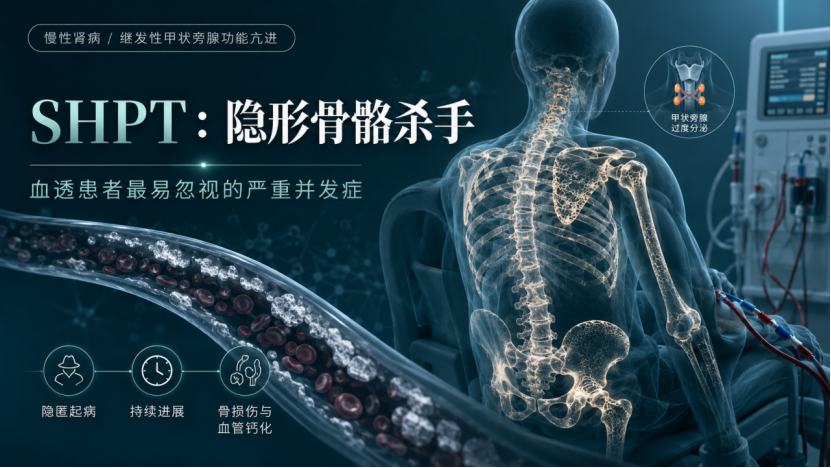
继发性甲旁亢SHPT确实是血透患者最易忽视、也最致命的“隐形杀手”。它不是单一的骨病,其杀伤力不在于某一次急性发作,而在于日复一日、悄无声息地对骨骼和血管的持续摧毁,是一套全身系统的连锁崩溃——心脑血管意外、全身发痒、骨密度降低等症状时有发生, 严重者还会导致死亡。
我国成人慢性肾脏病患病率高达10.8%,患者约1.2亿人。其中终末期肾衰竭尿毒症患者约138万人,透析是其主要治疗方案,而在接受透析的患者中,SHPT的并发率高达88%。它早期没有明显症状,等患者感到骨痛、乏力、身高变矮时,损害往往已经不可逆。这正是它被称为“隐形骨骼杀手”的原因。
肾衰竭后,身体里发生了什么?
要理解SHPT,先要理解健康人体内一套精密的“钙磷平衡系统”。
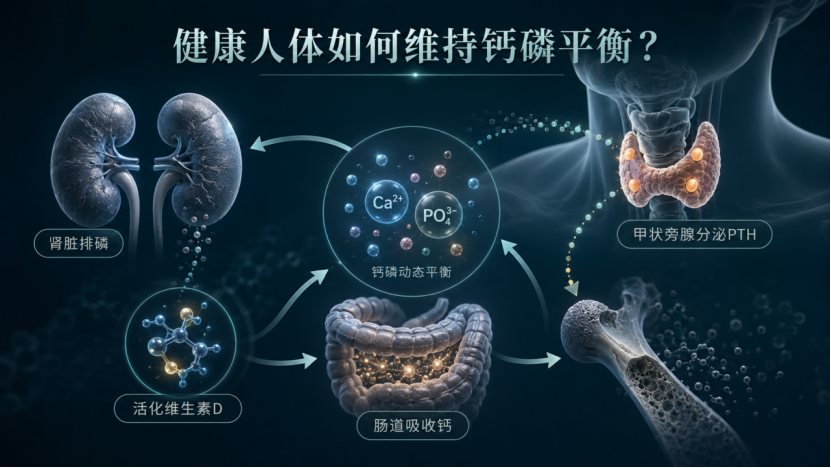
在健康人身上,肾脏每天负责清除多余的磷,同时活化维生素D帮助肠道吸收钙。血液里的钙和磷之间保持着一种此消彼长的动态平衡:血磷高了,血钙就会相应走低。
脖子上四个绿豆大小的甲状旁腺,扮演着一个“钙离子感应器” 的角色:一旦感知到血钙偏低,它立刻分泌甲状旁腺激素(PTH),命令骨骼释放钙入血,把血钙补回正常值。这套反馈机制在健康状态下运行得极其精准。
但当肾衰竭来临,一切都被打乱了。
肾脏排磷能力丧失后,血磷持续升高,血钙被“压”得越来越低。甲状旁腺为了把血钙拉回正常,只能拼命分泌PTH——这是高磷刺激甲状旁腺的第一条路径:血钙被压低,甲状旁腺被逼着“加班”。
但高磷的破坏力远不止于此。研究证实,血磷分子会直接作用于甲状旁腺细胞内部的信号通路,绕过血钙水平,直接刺激甲状旁腺分泌更多PTH。
更棘手的是,长期高磷刺激还会促使甲状旁腺细胞不断分裂增生,形成腺体增生甚至腺瘤。到了这个阶段,即使血钙水平恢复正常,甲状旁腺也已经“停不下来”,无法退回正常状态。
三条路径叠加——压低血钙间接刺激、直接促进PTH分泌、驱动甲状旁腺增生“扩产”,最终导致SHPT全面失控。
失控的PTH反过来会造成双重打击:
骨骼被“过度动员”
过高浓度的PTH持续从骨骼中动员钙质入血,骨量持续流失,骨质变得疏松脆弱。患者常表现为深部骨痛、易发骨折,严重时甚至出现身高变矮、面部缩小等骨骼畸形。
血管被“钙化”
血里多余的钙和磷无处可去,便在血管壁沉积,形成血管钙化。冠脉钙化、主动脉钙化、心瓣膜钙化……血管失去弹性,心脏负荷加重。而血管钙化,正是血透患者心梗、脑卒中和死亡的头号预测因子。
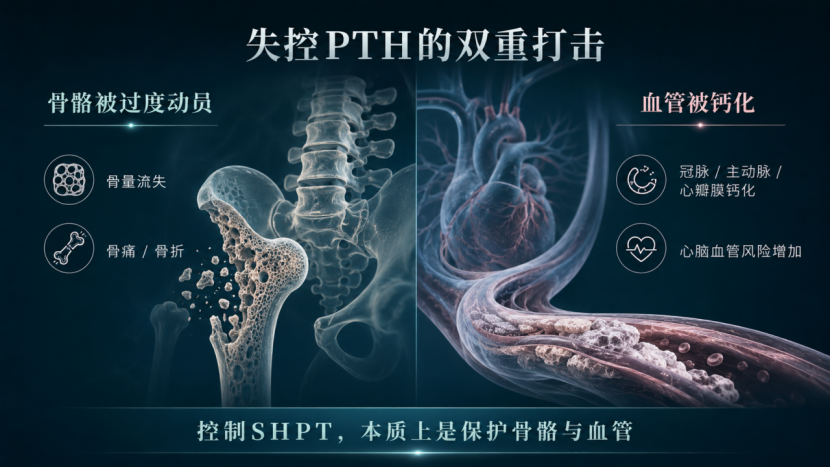
控制SHPT,本质上就是为了打破这个恶性循环——保护骨骼,延缓血管钙化进程。
现有治疗的临床困境
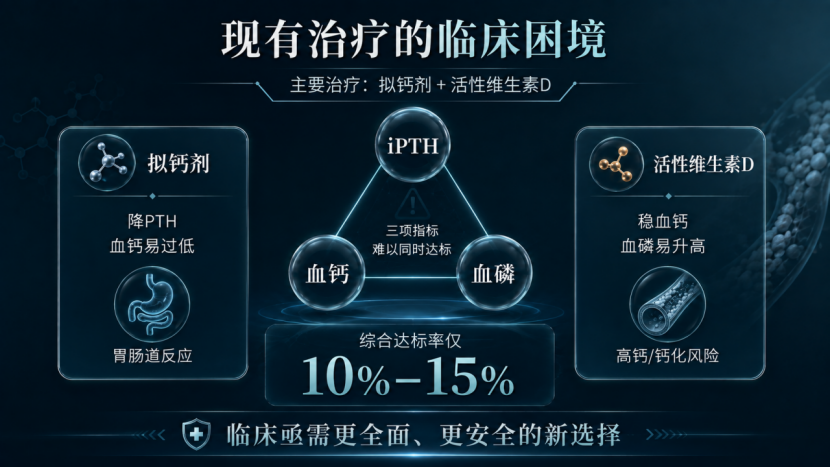
目前,SHPT的治疗主要依赖两类药物:拟钙剂(如西那卡塞、依特卡肽)和活性维生素D。
这些药物确实能降低PTH,但临床中始终绕不开一个“两难”:PTH降下来了,血钙可能也降得过低;想把血钙稳住,血磷又可能飙升。数据显示,即便联合用药,SHPT患者iPTH、血钙、血磷三项指标的综合达标率也仅徘徊在10%–15%。这意味着每10个接受规范治疗的患者中,有8到9个人的三项关键指标不能同时达标。
更棘手的是副作用。传统拟钙剂可能引发严重的胃肠道反应,部分患者恶心呕吐无法耐受,被迫中断治疗;活性维生素D则可能诱发高钙血症,增加血管钙化风险。
医生和患者都迫切需要一个更全面、更安全、能兼顾骨骼与心血管的新选择。
破局者MT1013:全球首创双靶点,标与本都管理
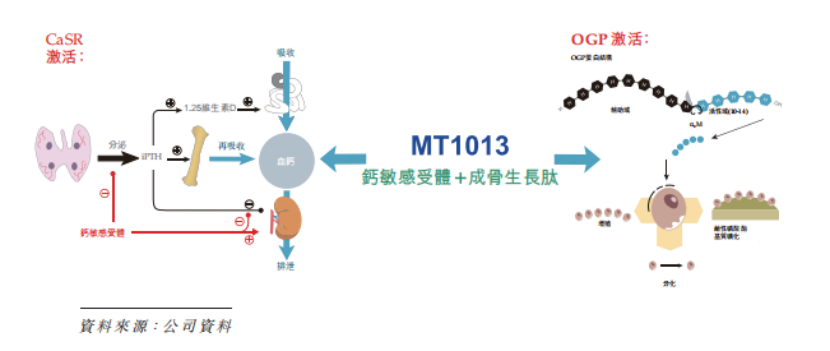
MT1013是麦科奥特自主研发的全球首创双靶点多肽药物,同时靶向钙敏感受体(CaSR)和成骨生长肽(OGP)受体。2025年,其与现有主流药物依特卡肽的头对头II期研究被美国肾脏病学会(ASN)年会收录为 “Late-Breaking Science”(最新突破性科学成果),标志着国际顶级学术界对其“同类首创”潜力的高度认可。
MT1013的两个靶点,对应着“治标”和“治本”两条战线同时推进:
第一靶点
CaSR——抑制PTH过度分泌
CaSR是甲状旁腺细胞表面的“钙感应器”。MT1013作用于这个受体,模拟血钙升高的信号,给甲状旁腺一个明确指令:“血钙已够,PTH减量分泌。”
这个机制与现有拟钙剂原理一致,但MT1013的分子设计更优。在II期头对头临床试验中,治疗20–27周后,MT1013组的综合达标率达到30.3%–42.86%,而依特卡肽组为12.12%–15.63%——MT1013是依特卡肽的2.5到3倍。此外,MT1013组的iPTH较基线降低超过30%的达标率高达83.9%–93.3%。这个靶点解决的是化验单上的急性异常:把过高的PTH、紊乱的钙磷快速拉回安全范围。
第二靶点
OGP受体——促进骨形成
这是MT1013独有的、现有任何SHPT药物都不具备的靶点。
OGP(成骨生长肽)是人体内天然存在的一种促骨形成因子,其功能是指令骨髓中的间充质干细胞分化为成骨细胞,启动骨骼的“施工重建”程序。
现有拟钙剂通过降低PTH来减少骨破坏,本质上是一种“抑制性”策略。MT1013激活OGP受体后,相当于直接下达了“启动骨形成”的指令,是一种“主动性”策略。两种机制协同,使得MT1013在控制PTH的同时,直接参与骨骼的修复与重建——这是目前任何现有SHPT药物都不具备的路径。
临床证据:四个维度的硬核数据
以下数据来自MT1013与依特卡肽的头对头II期临床试验(NCT06690242,共纳入114例患者),发表于2025年ASN年会。
01
综合达标率是依特卡肽的2.5倍
iPTH、血钙、血磷三项指标综合达标率:MT1013组30.3%–42.86% vs 依特卡肽组12.12%–15.63%,优势为后者的2.5–3倍。这打破了现有方案“控了PTH丢了钙磷”的僵局。
02
唯一实现骨密度显著提升
52周治疗后,股骨颈和腰椎骨密度显著提升(p<0.05)。这是SHPT治疗领域首次在药物临床试验中观察到明确的成骨获益,直接验证了OGP靶点的临床价值。
03
明确的心血管保护信号
MT1013降低心血管风险标志物FGF-23的幅度为34.87%–38.26%,而依特卡肽为21.31%,差异具有统计学意义(p<0.05)。FGF-23是独立于传统危险因素的心血管事件和全因死亡的强预测因子,其显著下降提示MT1013可能带来实质性的心血管获益。
04
优异的安全性与耐受性
II期研究中,MT1013组未观察到胃肠道不良反应,低钙血症发生率(7.7%)显著低于依特卡肽组(15.2%)。这意味着患者能够长期稳定用药,不必因副作用频繁停药或减量——这对于需要终身管理的慢性病而言,其价值不亚于疗效本身。
国际认可与研发进展
全球科学指导委员会
2026年2月,MT1013全球科学指导委员会首次会议召开,多名国际知名肾脏病及骨矿物质代谢领域权威专家就MT1013展现的临床试验结果和优势开展了深入探讨,就全球临床开发策略建言献策。

Geoffrey A. Block博士
现任U.S. Renal Care, Inc.副首席医疗官,曾担任KDIGO指南CKD-MBD工作组专家,参与超过130项临床试验,MT1013全球科学指导委员会主席。

Glenn M. Chertow教授
美国国家医学院院士,并曾担任两个 KDOQI 工作组的副主席及成员,为 KDOQI《慢性肾脏病骨代谢及疾病临床实践指南》的制定做出了贡献。

David C. Wheeler教授
现任英国伦敦大学学院肾脏医学教授、英国国家健康研究所肾脏疾病国家专科负责人,曾担任KDIGO联合主席及国际肾脏病学会(ISN)推进临床试验委员会主席。

Thomas L. Nickolas教授
华盛顿大学医学院圣路易斯分校的David C. and Betty Farrell内科学教授,并担任骨与矿物疾病科主任,KDIGO指南工作组、美国肾脏病学会、美国骨骼与矿物质研究学会的积极领导者。
Nickolas教授在2026年会议上明确指出:“MT1013有望成为全球首个获批用于治疗CKD相关骨质疏松症的药物,解决了该领域长期未被满足的医疗需求。”
商业化进展
2026年2月,云顶新耀与麦科奥特达成协议,获得MT1013在中国及亚太地区(除日本外)的独家商业化权益,首付款及里程碑金额最高达12.4亿元。
研发进度
MT1013的Ⅲ期临床试验已于2026年4月完成全部424名患者入组,以西那卡塞为阳性对照,预计2027年初提交上市申请。
MICOT
“Dialysis does not scare me. What scares me is feeling as if ants are gnawing at my bones.”
A patient on dialysis for eight years once said this. By “ants gnawing at my bones,” he meant the bone pain caused by secondary hyperparathyroidism (SHPT)—deep aching and stabbing pain that kept him awake at night as analgesics became less effective.
SHPT is one of the most overlooked yet serious complications in hemodialysis patients. It is not simply a bone disease. Its harm lies not in a single acute episode, but in persistent, often silent damage to bones and blood vessels—a systemic cascade that can lead to cardiovascular and cerebrovascular events, generalized pruritus, reduced bone mineral density (BMD) and, in severe cases, death.
An earlier national survey reported a CKD prevalence of 10.8% among Chinese adults, or about 120 million people. Dialysis is a major treatment for kidney failure, and SHPT is highly prevalent among dialysis patients.
SHPT often has no obvious early symptoms. By the time bone pain, weakness or loss of height develops, substantial skeletal damage may already have occurred—hence the name “silent bone killer.”
What Happens After Kidney Failure?
To understand SHPT, first consider the body's tightly regulated calcium-phosphate balance.
Healthy kidneys excrete excess phosphate and activate vitamin D to support intestinal calcium absorption. Together, these mechanisms help maintain calcium and phosphate homeostasis.
The four tiny parathyroid glands in the neck act as calcium sensors. When serum calcium falls, they secrete parathyroid hormone (PTH), which helps restore calcium levels, including by mobilizing calcium from bone.
In healthy people, this feedback loop is tightly controlled.
Kidney failure disrupts it.
Impaired phosphate excretion causes phosphate retention, while reduced vitamin D activation impairs calcium absorption. These changes stimulate the parathyroid glands to secrete more PTH.
But high phosphate does more than lower calcium. It can also directly affect signaling within parathyroid cells and stimulate PTH secretion independently of serum calcium. Persistent phosphate stimulation can further drive parathyroid hyperplasia, making the glands progressively less responsive to normal feedback and, in advanced disease, increasingly autonomous.
Together, indirect stimulation through altered calcium balance, direct stimulation of PTH secretion, and progressive parathyroid hyperplasia reinforce one another and drive SHPT progression.
Excess PTH then causes two major problems:
Excessive Bone Turnover
Persistently high PTH mobilizes calcium from bone, causing progressive bone loss and fragility. Patients may develop deep bone pain, fractures and, in severe longstanding disease, loss of height and skeletal deformities.
Vascular Calcification
Disordered calcium-phosphate metabolism promotes mineral deposition in blood vessels and valves, including the coronary arteries, aorta and cardiac valves. This reduces vascular elasticity and increases cardiovascular burden.
Controlling SHPT therefore means breaking this vicious cycle—protecting bone and slowing vascular calcification.
Limitations of Current Treatment
Current SHPT treatment mainly relies on calcimimetics, such as cinacalcet and etelcalcetide, and active vitamin D.
These agents can indeed lower PTH, yet clinicians are constantly confronted with a clinical dilemma: reducing PTH may drive excessive hypocalcemia, whereas stabilizing serum calcium may trigger a sharp rise in serum phosphate. Data indicate that even with combination therapy, the composite achievement rate for the three key parameters — iPTH, serum calcium and serum phosphate — among patients with secondary hyperparathyroidism (SHPT) hovers at merely 10%‑15%. This translates to 8‑9 out of every 10 patients receiving standard‑of‑care therapy failing to meet all three target benchmarks simultaneously.
Adverse effects are another challenge. Calcimimetics may cause hypocalcemia, while oral cinacalcet commonly causes gastrointestinal adverse effects such as nausea and vomiting. Active vitamin D may raise calcium and phosphate, requiring careful monitoring.
Clinicians and patients therefore need a more comprehensive and well-tolerated option that addresses both skeletal and cardiovascular risk.
MT1013: A First-in-Class Dual-Target Approach to Both Immediate and Underlying Disease Management
MT1013, independently developed by Shaanxi Micot Pharmaceutical Technology Co., Ltd., is a first-in-class dual-targeting receptor agonist polypeptide targeting both the calcium-sensing receptor (CaSR) and osteogenic growth peptide (OGP) receptor. This is consistent with Micot's Hong Kong listing documents.
In 2025, its head-to-head Phase II study versus etelcalcetide was presented as "Late-Breaking Science" at American Society of Nephrology (ASN) Kidney Week 2025. The study enrolled 114 patients and is registered as NCT06690242.
The two targets address complementary aspects of SHPT management.
Target 1
CaSR — Suppressing Excess PTH Secretion
CaSR is the calcium sensor on parathyroid cells. By activating CaSR, MT1013 mimics the signal of increased extracellular calcium, thereby suppressing excessive PTH secretion.
This mechanism is shared with existing calcimimetics, but MT1013 adds a second target.
In the Phase II head-to-head study, during Weeks 20–27, simultaneous iPTH/calcium/phosphate target attainment was 34.48%–39.29% with MT1013 versus 15.63% with etelcalcetide—about 2.2–2.5 times higher. Micot's listing documents also report an early onset of iPTH-lowering efficacy, with effects observed within three weeks and stable control by Week 9.
At Week 26, 83.9% and 93.3% of patients in the two MT1013 groups achieved >30% iPTH reduction.
Thus, the CaSR component addresses the biochemical abnormalities of SHPT by rapidly lowering excessive PTH while supporting broader mineral control.
Target 2
OGP Receptor — Promoting Bone Formation
The OGP receptor is the differentiating component of MT1013's dual-target design.
OGP (osteogenic growth peptide) is an endogenous osteogenic peptide that promotes mesenchymal stem cell differentiation into osteoblasts and supports bone formation. ASN's official abstract describes the OGP pathway accordingly.
Existing calcimimetics mainly reduce excessive bone turnover indirectly by lowering PTH—essentially an inhibitory strategy. By engaging the OGP pathway, MT1013 is designed to actively support bone formation.
The two mechanisms therefore work in parallel: CaSR activation controls excessive PTH secretion, while OGP receptor engagement supports bone formation and remodeling. This provides a mechanistically differentiated approach from existing single-target calcimimetics.
Clinical Evidence: Four Key Findings
The following findings come from MT1013 Phase II studies, including the head-to-head study versus etelcalcetide (NCT06690242; n=114) presented at ASN Kidney Week 2025.
01
About 2.5-Fold Higher Comprehensive Control Rate
During Weeks 20–27, simultaneous iPTH/calcium/phosphate target attainment was 34.48%–39.29% with MT1013 versus 15.63% with etelcalcetide, approximately 2.2–2.5 times higher.
This addresses a key limitation of current treatment: controlling PTH while maintaining calcium and phosphate control.
02
Significant BMD Improvement
In the Phase II MT1013-II-C01 study, patients with low bone mass or osteoporosis at baseline showed significant increases in lumbar-spine and femoral-neck BMD after MT1013 treatment.
At Week 52, lumbar-spine BMD increased by 1.65% and femoral-neck BMD by 4.44% from baseline. Bone-turnover markers also improved, consistent with improvement in the high-turnover bone state associated with SHPT.
These findings support the potential skeletal benefits of MT1013's dual-target mechanism.
03
FGF-23 Reduction and a Potential Cardiovascular Benefit Signal
Fibroblast growth factor 23 (FGF-23) is associated with disordered mineral metabolism in CKD and adverse cardiovascular outcomes.
In the ASN analysis, FGF-23 fell by 34.87% and 38.26% in the two MT1013 groups versus 21.31% with etelcalcetide, with ASN reporting a trend toward superiority for MT1013. A higher proportion of MT1013-treated patients also achieved >30% FGF-23 reduction.
The greater FGF-23 reduction suggests a potential cardiovascular benefit, although cardiovascular outcome benefits require further confirmation.
04
Favorable Safety and Tolerability
In the head-to-head Phase II study, hypocalcemia occurred in 7.7% with MT1013 versus 12.1% with etelcalcetide, with no severe hypocalcemia reported.
Gastrointestinal treatment-related adverse reactions were also generally less frequent with MT1013. In long-term Phase II studies, nausea and vomiting were each reported in about 1.5% of MT1013-treated patients.
For a chronic disease requiring long-term management, favorable tolerability is important for sustained treatment.
International Recognition and Development Progress
Global Scientific Steering Committee
In February 2026, the inaugural meeting of the MT1013 Global Scientific Steering Committee was convened. Multiple internationally‑renowned authorities in nephrology and bone‑mineral metabolism conducted in‑depth discussions on the clinical trial findings and advantages demonstrated by MT1013, and offered advice on its global clinical development strategy.
Geoffrey A. Block
Deputy Chief Medical Officer at U.S. Renal Care, Inc. A previous member of KDIGO Guideline CKD-MBD Work Group ,Principal Investigator for over 130 clinical trials. Chairman of MT1013 Global Scientific Steering Committee.
Glenn M. Chertow
Elected to the National Academy of Medicine in 2015. A former member and Vice‑Chair of two KDOQI work groups, contributing to the development of the KDOQI Clinical Practice Guideline for Bone Metabolism and Disease in Chronic Kidney Disease.
David C. Wheeler
Professor of Kidney Medicine at University College London and National Specialty Lead for Renal Disorders at the UK’s National Institute for Health and Care Research (NIHR). Previous Co-Chair of KDIGO and Chair of the International Society of Nephrology (ISN) Advancing Clinical Trials Committee.
Thomas L. Nickolas
David C. and Betty Farrell Professor of Medicine at Washington University School of Medicine in St. Louis, and Chief of the Division of Bone and Mineral Diseases. An active leader within the KDIGO Guideline Work Group, the American Society of Nephrology, and the American Society for Bone and Mineral Research.
At a 2026 meeting, Professor Nickolas highlighted MT1013's potential to become the first approved therapy for CKD-related osteoporosis, addressing a major unmet medical need.
Commercialization
In Fe 2026, Everest Medicines entered into an exclusive license agreement with Micot for MT1013 commercialization in China and Asia-Pacific, excluding Japan.
Micot is entitled to an RMB200 million upfront payment and up to RMB1.04 billion in regulatory and commercial milestone payments, totaling up to RMB1.24 billion, plus royalties. The RMB200 million upfront payment had been received as of the latest practicable date disclosed in the listing document.
Clinical Development
MT1013 is in a confirmatory Phase III trial in China, with cinacalcet as the active comparator.
The multicenter, randomized, double-blind, double-dummy study has enrolled all 424 planned patients in April 2026.
Micot expects to complete Phase III by end-2026, submit an NDA in early 2027.
MICOT
详情
奋斗为本、求是创新、协作共赢
